Dusky Pionus Parrot
Dusky Pionus Parrot (Pionus fuscus), frequently referred to as the Dusky Parrot, is a medium-sized parrot species that belongs to the Pionus genus, a collection of Neotropical parrots celebrated for their gentle temperaments, subtle plumage variations, and adaptability to both wild and captive environments. Originating from the verdant tropical forests of Central and South America, this bird is distinguished by its earthy, camouflaged appearance and serene demeanor, which set it apart from more flamboyant parrot species. Its dusky brown and maroon tones allow it to blend effortlessly into the dappled light of rainforest understories, providing a natural defense against predators while highlighting its evolutionary adaptation to humid, dense habitats. In the wild, Dusky Pionus Parrot play a vital ecological role as social flock members that aid in seed dispersal, consuming fruits, nuts, and berries and excreting viable seeds that promote forest regeneration and biodiversity. This process helps maintain the health of tropical ecosystems, supporting a wide array of plant species and, by extension, the animals that depend on them. With an estimated population numbering in the hundreds of thousands across its range, the Dusky Pionus Parrot is classified as Least Concern by the IUCN Red List, indicating a relatively stable status overall. However, this classification belies localized vulnerabilities, as ongoing deforestation for agricultural purposes, logging operations, and infrastructure development continues to fragment habitats and reduce population connectivity. Climate change further threatens the species by disrupting rainfall patterns, leading to droughts that can diminish food resources and complicate breeding efforts. In captivity, Dusky Pionus Parrot are cherished for their quiet, affectionate nature—they are among the less vocal parrots, making them suitable for environments where noise is a concern—and their capacity for forming deep, loyal bonds with owners. Their intelligence allows them to learn simple tricks, mimic basic sounds, and engage in interactive play, while their longevity of up to 40 years ensures a rewarding, long-term companionship for committed caretakers. Nonetheless, they require consistent mental and physical stimulation to prevent boredom-induced behaviors like feather plucking or excessive chewing. Ethical considerations are paramount in ownership, as wild-caught birds can fuel illegal trade networks, so prioritizing adoption from reputable breeders or rescue organizations is essential. The Dusky Pionus serves as a poignant symbol of the understated beauty and resilience of tropical biodiversity, underscoring the need for sustainable practices to protect these irreplaceable habitats and the species that inhabit them.
Physical Description
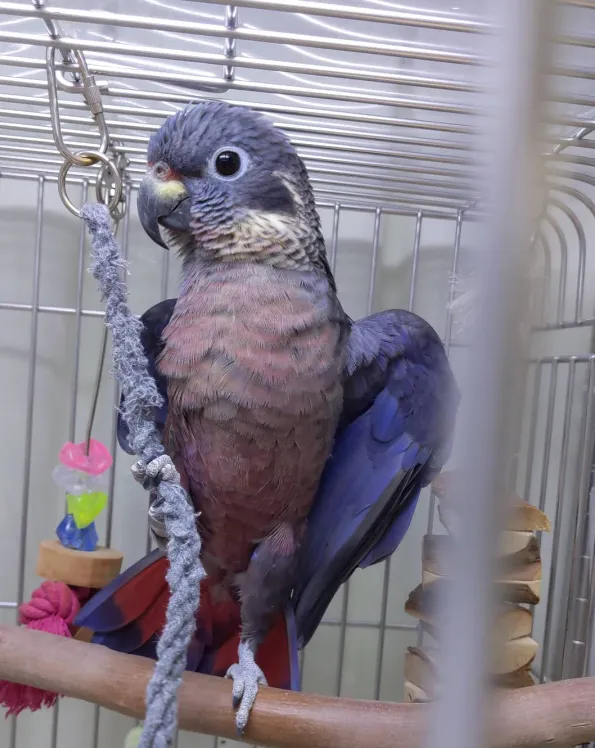
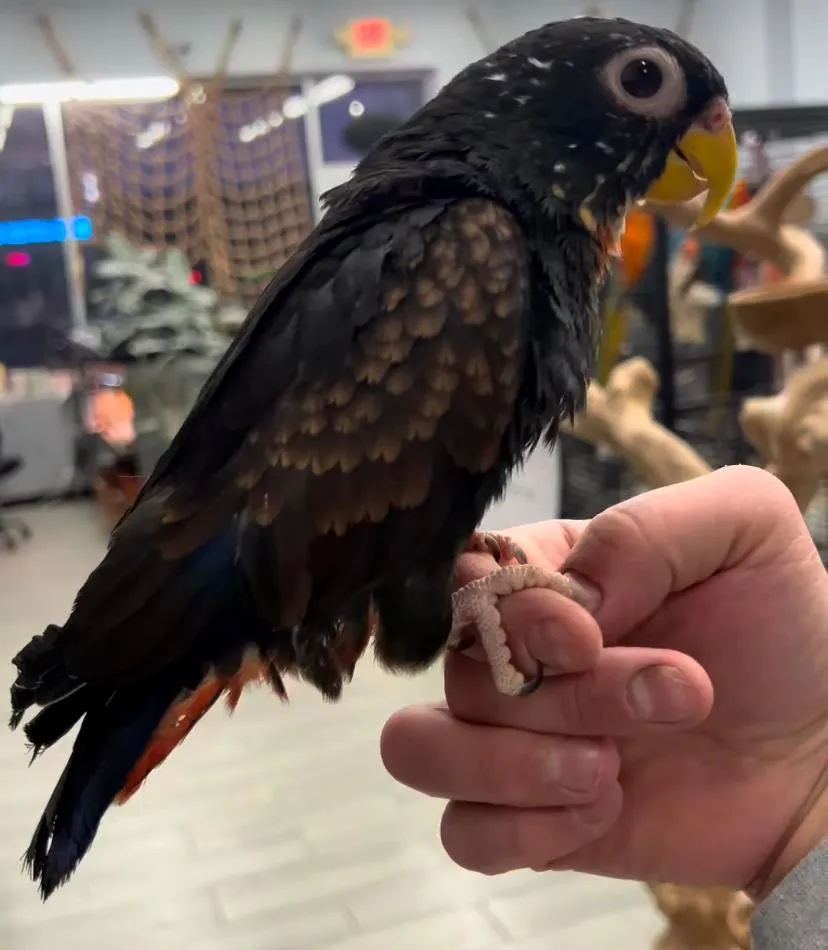
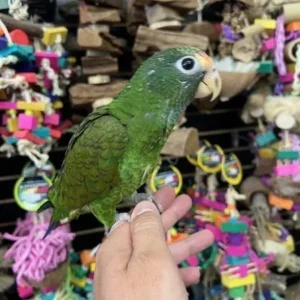
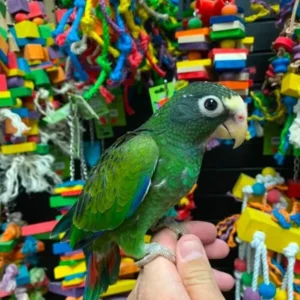
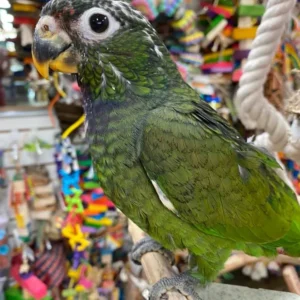
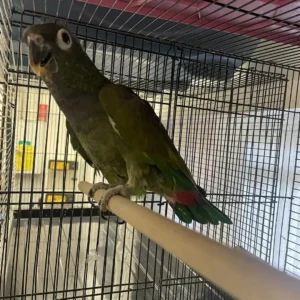
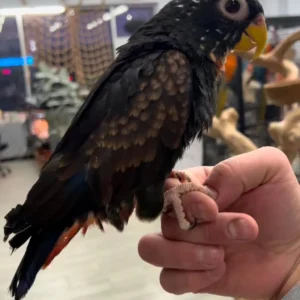
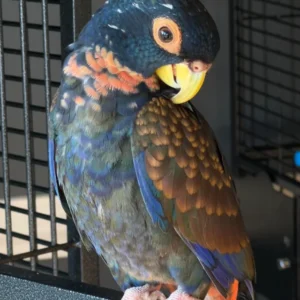
The Dusky Pionus Parrot presents a compact and elegantly understated physique, with a body length of 24-26 cm (9-10 inches) from the tip of its beak to the end of its tail, a wingspan extending 40-45 cm (16-18 inches) for agile navigation through foliage, and a weight ranging from 150-200 grams (5-7 ounces), making it one of the smaller members of the Pionus family. Its plumage is a masterful study in earthy camouflage, dominated by dusky brown or olive-brown feathers that cover the back, wings, and tail, providing seamless blending into the shadowed understories of tropical forests. Dusky Pionus Parrot head is adorned with a distinctive maroon or reddish-brown cap that extends to the nape, offering a subtle yet striking contrast to the neutral body tones, while the throat and upper chest reveal delicate blue-gray or lavender hues that can shimmer faintly under direct light, adding a layer of understated iridescence. The beak is robust yet proportionate, dark gray to black in color, and slightly curved at the tip, optimized for cracking open hard-shelled seeds and nuts without the exaggerated size seen in larger parrots. Eyes are prominent, dark brown, and highly expressive, encircled by bare, pale gray or whitish skin that may exhibit a slight rosy tint during moments of arousal or stress, enhancing the bird’s communicative visage. Dusky Pionus Parrot tail is elongated and tapered, composed of brown feathers with occasional red or bronze undertones, particularly visible when fanned, which aids in balance and directional control during flight or perching. Wings are broad and rounded, with primaries and secondaries in matching dusky shades, though close inspection might reveal subtle metallic highlights on the flight feathers in some individuals, especially adults. Sexual dimorphism is generally subtle and not easily discernible without careful comparison; males often display marginally brighter maroon on the head and more vivid blue-gray accents on the chest, while females may appear slightly duller overall, but these differences are best confirmed through behavioral observations, vocal cues, or genetic testing. Juveniles embody an even more muted version of adult plumage, with faded browns lacking the defined maroon cap and lavender throat, which gradually develop through successive molts over 1-2 years, reflecting the bird’s maturation process. Dusky Pionus Parrot feet are zygodactylous, featuring two toes facing forward and two backward, each equipped with strong, curved claws for securely grasping branches, perches, and foraging substrates. In flight, the Dusky Pionus Parrot exhibits a smooth, rhythmic wingbeat interspersed with gentle glides, allowing it to maneuver deftly through dense vegetation with minimal noise. Overall, Dusky Pionus Parrot physical attributes combine functionality with a quiet elegance, embodying the adaptive perfection of a species finely tuned to its rainforest home while offering subtle visual charms that reward attentive observation.
Habitat and Distribution
The Dusky Pionus Parrot is indigenous to the lush, humid tropical zones of Central and South America, with its range encompassing Costa Rica and Panama in the northern extent, extending southward through Colombia and Venezuela, and potentially reaching into adjacent areas of Ecuador and Peru. It predominantly occupies lowland and montane rainforests, cloud forests, and transitional forest edges, thriving at elevations between 500-2,000 meters (1,640-6,560 feet) where high humidity, dense canopy cover, and abundant vegetation create ideal conditions for foraging, nesting, and social interactions. These habitats are characterized by a rich diversity of fruit-bearing trees, understory shrubs, and epiphytes, providing a steady supply of food and shelter, alongside access to streams or rivers for hydration. Dusky Pionus Parrot species demonstrates a degree of adaptability, occasionally venturing into secondary growth forests or lightly disturbed woodlands, but it shuns open savannas, arid plains, or heavily deforested areas. Geographical barriers such as mountain ranges, river valleys, and coastal features influence its distribution, potentially leading to isolated subpopulations with slight variations in plumage intensity or behavior. Deforestation remains the primary threat, driven by agricultural expansion for crops like coffee, cocoa, and palm oil, which clears vast tracts of forest and fragments remaining habitats, reducing genetic diversity and increasing susceptibility to predation or disease. Logging for timber and infrastructure projects, including roads and hydroelectric dams, further exacerbate habitat loss, particularly in biodiverse hotspots like the Andean foothills and Central American highlands. Climate change introduces compounding effects, with shifting precipitation patterns causing prolonged droughts that deplete fruit resources and disrupt breeding synchrony, potentially leading to lower reproductive success. Protected areas, such as national parks and biosphere reserves in Costa Rica, Colombia, and Panama, offer critical sanctuaries, but inadequate enforcement and illegal activities often undermine their effectiveness. In captivity, mimicking these natural conditions requires enclosures that maintain warmth, humidity, and access to natural elements like live plants or branches, ensuring the birds’ physical and behavioral health is preserved.
Behavior and Diet
Dusky Pionus Parrot are quintessential social beings, typically congregating in small to medium-sized flocks of 10-30 individuals that collaborate in foraging, roosting, and evading threats, fostering a cooperative dynamic that enhances survival in complex environments. As diurnal creatures, they are active from the early morning hours until dusk, engaging in a repertoire of calm, inquisitive behaviors such as gentle mutual preening, exploratory perching on branches, and occasional playful interactions like soft vocal duets or synchronized movements. Their intelligence shines through in problem-solving tasks, such as manipulating twigs or leaves to access hidden food, and they form enduring monogamous pair bonds marked by affectionate grooming and coordinated displays. In the wild, they maintain a wary yet curious stance toward humans, often observing from elevated perches before retreating into the canopy.
Dietarily, Dusky Pionus Parrot are opportunistic omnivores, with a primary reliance on fruits, seeds, nuts, berries, and flowers, supplemented by insects, larvae, or small invertebrates for protein enrichment. Foraging strategies involve plucking ripe items from trees, shrubs, or the forest floor, using their beaks and feet in tandem. In captivity, a nutritionally balanced regimen includes high-quality parrot pellets as the foundation, enriched with fresh fruits (such as apples, bananas, and mangoes), vegetables (carrots, broccoli, and leafy greens), and controlled portions of seeds or nuts to prevent obesity. Foraging enrichment tools, like puzzle feeders or scatter feeding, are indispensable for replicating natural eating habits, stimulating mental acuity, and averting dietary monotony that could lead to health issues.
Breeding and Reproduction
Breeding activities in Dusky Pionus Parrot are generally timed to coincide with the wetter seasons, when food abundance supports reproductive efforts, though exact timing varies by region. Monogamous pairs select secluded tree hollows or natural cavities in mature trees, often at moderate heights to deter predators, and may line the nest with soft materials like wood chips or feathers. Females typically lay 3-4 white, oval eggs, which are incubated by both parents for approximately 24-26 days, with the male assisting in feeding and protection. Chicks emerge altricial, entirely dependent on parental regurgitation of food, and undergo rapid development, fledging after 8-10 weeks. Post-fledging, they remain under parental guidance for several additional weeks, learning essential foraging and social skills. In the wild, breeding success rates hover around 60-80%, contingent on habitat stability, food availability, and absence of disturbances like predation by snakes, birds of prey, or introduced mammals. Captive breeding mirrors these patterns, with pairs often producing multiple clutches annually under optimal conditions.
Vocalizations and Communication
Dusky Pionus Parrot communicate through a soft, melodic array of whistles, chirps, and low-pitched calls that facilitate flock cohesion, pair bonding, and territorial signaling without the raucousness of louder parrot species. Their vocal repertoire includes gentle contact calls for maintaining group proximity and subtler sounds for courtship or alarm. While not prolific mimics compared to African Greys or Amazons, they can learn to imitate simple whistles, household noises, or basic phrases with practice, adding a layer of interactivity in captive settings.
Health and Common Issues
As a hardy species, Dusky Pionus Parrot are generally resilient but can encounter challenges such as nutritional deficiencies from imbalanced diets, leading to issues like weakened immunity or feather abnormalities. Stress-related behaviors, including feather plucking or excessive vocalization, may arise from inadequate stimulation or environmental changes. Lifespan in the wild is 30-40 years, extending to similar or longer durations in captivity with attentive care. Regular veterinary oversight, including check-ups and blood tests for avian diseases, is recommended to monitor for conditions like psittacosis or parasitic infections.
As Pets: Care, Training, and Considerations
Dusky Pionus Parrot make endearing pets for those seeking a calm, affectionate companion, responding well to positive reinforcement training for tricks, commands, or basic mimicry. They require moderate-sized enclosures with perches, toys, and daily interaction to thrive, forming strong attachments with consistent handlers.
Conservation and Cultural Significance
Least Concern overall, but habitat pressures warrant vigilance. In regional cultures, they symbolize quiet wisdom and forest harmony.
1 review for Dusky Pionus Parrot
Add a review
Related products
Pionus
Pionus
Pionus
Noah Garcia –
Dusky pionus parrot are delightful. My guy, Pearl, is affectionate, mimics well, and has stunning white feathers. Best pet ever!