



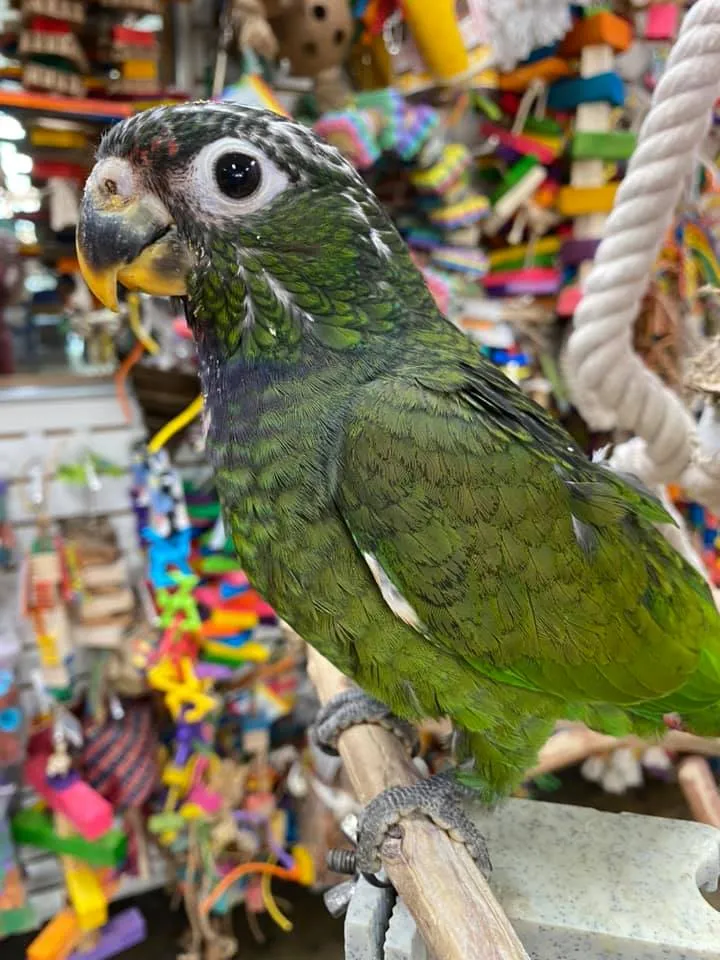
White Capped Pionus
White Capped Pionus (Pionus senilis), commonly known as the White-crowned Pionus or White-headed Pionus, is a medium-sized parrot species belonging to the Pionus genus, a group of Neotropical parrots renowned for their gentle dispositions, subtle beauty, and remarkable adaptability to both wild and captive environments. Named for the distinctive white cap that crowns its head, this bird is native to the humid tropical forests of Central America, where it contributes to ecosystem health as a seed disperser, helping regenerate forests by spreading the seeds of fruits, nuts, and berries it consumes. Its population, estimated in the hundreds of thousands, is classified as Least Concern by the IUCN Red List, indicating overall stability, though localized threats from habitat destruction persist. Deforestation for agriculture, logging, and urban development has fragmented its range, potentially leading to declines in unprotected areas. Climate change adds complexity by altering rainfall patterns, which can affect breeding and food availability. In captivity, White Capped Pionus are highly prized as pets for their quiet, affectionate nature—White Capped Pionus are among the less vocal parrots, making them suitable for noise-sensitive households—and their capacity for forming deep, loyal bonds with owners. Their intelligence allows them to learn simple tricks, mimic basic sounds, and engage in interactive play, while their longevity of up to 40 years ensures a rewarding, long-term companionship for committed caretakers. However, they require mental stimulation to prevent boredom-related behaviors like feather plucking or excessive chewing. Ethical ownership is crucial, as wild-caught birds can support illegal trade, so adopting from reputable breeders or rescue organizations is advocated. The White Capped Pionus embodies the serene elegance of Central American rainforests, serving as a reminder of the importance of preserving these biodiverse habitats for future generations.
Physical Description
The White Capped Pionus is a delicately built parrot with a compact, streamlined form, measuring 25-28 cm (10-11 inches) in length from beak to tail, boasting a wingspan of 42-48 cm (17-19 inches) for agile navigation through dense foliage, and weighing 180-220 grams (6-8 ounces). Its plumage is a harmonious blend of greens and striking contrasts, with the body primarily olive-green or yellowish-green, providing excellent camouflage in forested environments. White Capped Pionus most distinctive feature is the white cap on the head, formed by pure white feathers that cover the crown, forehead, and sometimes the nape, creating a bold contrast against the green body and adding a touch of elegance. The throat and upper chest display soft blue-gray or lavender hues that can shimmer subtly in sunlight, while the wings and tail are similarly green, with the tail being long and tapered for balance. The beak is stout, dark gray to black, and slightly curved, adapted for cracking seeds and nuts without the bulk of larger parrots. Eyes are large, dark brown, and expressive, framed by bare, pale gray or whitish skin that may flush slightly during excitement. The overall appearance is one of quiet sophistication, with the white cap providing a clean, eye-catching focal point that makes this species easily identifiable. Sexual dimorphism is subtle and often imperceptible; males may exhibit slightly brighter white caps and blue-gray accents, while females appear marginally duller, but behavioral cues or DNA testing are typically needed for confirmation. Juveniles lack the full white cap, presenting a plainer green head that develops the characteristic white over 1-2 years through molting. White Capped Pionus feet are zygodactylous, with strong, curved claws for gripping branches and foraging. In flight, the White Capped Pionus displays a smooth, undulating pattern with quick wingbeats, allowing it to maneuver through forest canopies with grace. This physical design reflects its evolutionary adaptation to a life in trees, combining functionality with an aesthetic that appeals to bird enthusiasts.
Habitat and Distribution
The White Capped Pionus is endemic to the tropical regions of Central America, with a range spanning from southern Mexico (including the Yucatan Peninsula and Chiapas) through Guatemala, Belize, El Salvador, Honduras, Nicaragua, Costa Rica, and into western Panama. It inhabits a variety of humid, forested ecosystems, including lowland and montane rainforests, cloud forests, and forest edges, typically at elevations of 500-2,500 meters (1,640-8,200 feet), where high moisture and dense vegetation provide ideal conditions for foraging and nesting. These habitats are rich in fruit-bearing trees, epiphytes, and understory shrubs, offering abundant food and shelter. White Capped Pionus species shows adaptability, occasionally venturing into secondary forests or disturbed woodlands, but it avoids open savannas or arid areas. Its distribution is shaped by geographical features like mountain ranges and river systems, which can isolate populations. Deforestation driven by agricultural expansion (e.g., for coffee, bananas, or palm oil), logging, and infrastructure development has severely impacted its range, reducing habitat connectivity and increasing vulnerability to predation or disease. In regions like the Mesoamerican Biological Corridor, rapid land conversion has fragmented populations, while climate change exacerbates issues with altered precipitation causing droughts that affect fruit production. Protected areas, such as national parks in Costa Rica and Guatemala, serve as vital refuges, but enforcement challenges persist. In captivity, replicating these conditions involves providing warm, humid enclosures with natural elements like branches and foliage to support health and behavior.
Behavior and Diet
White Capped Pionus are inherently social and flock-oriented, typically forming groups of 10-30 individuals that forage, roost, and travel together, fostering cooperation and safety in complex environments. White Capped Pionus are diurnal, active from dawn to dusk, and exhibit calm, inquisitive behaviors like gentle preening, exploratory perching, and soft vocal exchanges. Intelligent and observant, they can engage in simple problem-solving and form monogamous pair bonds. In the wild, they are wary but curious. Dietarily, they are omnivorous, focusing on fruits, seeds, nuts, berries, and insects; in captivity, provide balanced pellets, fresh produce, and foraging toys.
Breeding and Reproduction
Breeding occurs in tree cavities, with 3-4 eggs incubated for 24-26 days. Chicks fledge after 8-10 weeks.
Vocalizations and Communication
Soft whistles and chirps; capable of simple mimicry.
Health and Common Issues
Susceptible to nutritional deficiencies. Lifespan: 30-40 years.
As Pets: Care, Training, and Considerations
Affectionate and trainable with positive methods; require moderate space and interaction.
Conservation and Cultural Significance
Least Concern; valued in regional folklore.
3 reviews for White Capped Pionus
Add a review
Related products
Pionus
Pionus
Pionus
Isabella Kim –
White capped pionus are wonderful. My bird, Comet, is curious, affectionate, and easy to care for. Gorgeous white plumage
Ethan Wong –
My White capped pionus, Dusty, is a joy. Intelligent, playful, and bonds deeply. Her bare eyes make her expressive.
Sophia Patel –
White cap pionus named Frost is my favorite. Affectionate, mimics sounds, and has stunning feathers. Perfect companion!